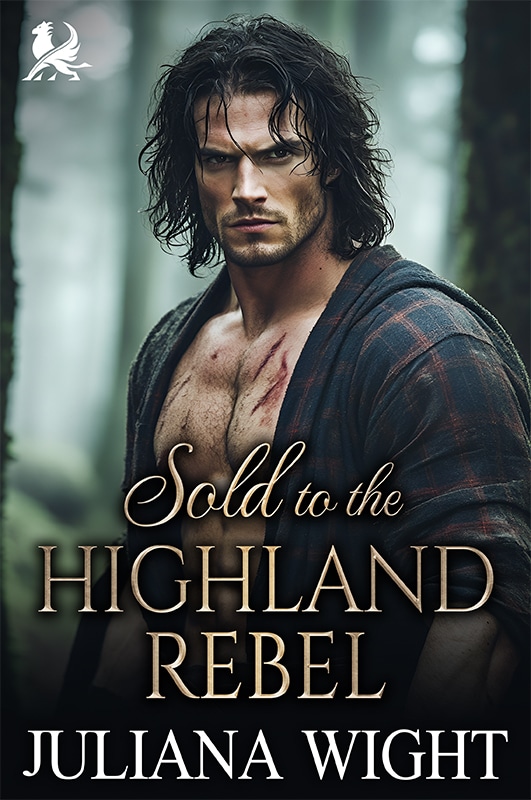
Sold to the Highland Rebel (Preview)

Chapter One
1656, Croft Estate
“You’ve not even looked back once.”
Rosalind kept her eyes anchored to the mud-slicked road ahead, her spine rigid against the rhythmic swaying of the carriage.
A sharp jolt racked the frame as the wheels dropped into a deep, water-logged rut. She pressed her palm flat against the cold leather seat to steady herself, her fingers cramping with the effort to remain still.
“I looked back,” she stated, her voice sounding thin and brittle in the cramped space.
“You didn’t.”
“I did. Before you climbed in.”
Bethany made a soft, clicking sound with her tongue, a noise that was not quite agreement.
She was watching Rosalind with that quiet, pervasive intensity she always possessed. Her gaze not a stare, but a constant presence, like a single candle flame in a drafty room. She was close enough to notice the slight tremor in Rosalind’s jaw, the way her knuckles had turned as white as the frost on the windows.
Rosalind had made herself a jagged promise before the carriage door had finally latched shut. She had stood in the hollow entrance hall of Croft Estate one last time, wrapped in a silence that had lived there since the fever took her parents three weeks ago, and she had been very clear with herself.
Don’t look back. There is nothing left to look at.
It was a promise that felt easier to keep when she knew Bethany was weighing her every flinch.
“You could have taken longer,” Bethany said quietly, her voice softening with a sympathy that Rosalind wasn’t sure she could bear. “No one would have said a word, my lady.”
“The solicitor said the estate passes to my uncle’s management by the end of the month.”
Rosalind focused on a tiny, imaginary crease in the wool of her skirt, smoothing it over and over until her fingertips felt raw. “Staying longer would only have meant watching it stop being mine in person. I’d rather the road than the slow rot of waiting.”
Bethany said nothing.
That was one of the things Rosalind had always valued most about the woman. She knew when words were the wrong tool.
Outside, the grey morning smeared past the small window in jagged pieces. Low stone walls, bare fields, and trees stripped to their skeletal bones by the season, their black branches cutting up against a sky the heavy color of old pewter.
Father had loved this time of year.
He’d called it honest.
The land shows you what it truly is in winter, Rosie. No prettiness. No hiding.
The memory of his voice brought a sudden, hot prickle to the back of her eyes. She pressed her thumbnail deep into the meat of her palm, the sharp sting grounding her, and forced herself to stop thinking about him.
“How long until we reach the border?” she asked, her voice tight.
“Thomas said four days if the roads hold.” Bethany adjusted the heavy woolen blanket across her lap, her movements restless. “Five if they don’t.”
“They won’t.”
Bethany smiled faintly, a ghost of an expression that didn’t reach her worried eyes. “No. They won’t.”
The roads didn’t hold.
By the second day, the carriage wheels were grinding and screaming through mud thick enough to slow them to a walking pace, and the sky had dropped so low it seemed to rest heavily on the treeline.
The landscape had curdled around them without Rosalind quite noticing when the gentle southern rolls replaced by something older, darker, and less forgiving. Great hills began to crowd the road on both sides like slumbering giants, and the ancient forest pressed closer with every grueling mile.
She watched the light shift through the glass, turning flatter and greener, stripped of all warmth, and felt the first real coil of unease settle into the pit of her stomach.
It wasn’t grief. Grief, she knew. It was a heavy, familiar cloak.
This was different. Quieter. It was the primal feeling of being watched by something that hadn’t quite decided what to do with her yet.
Thomas brought his horse alongside the window on the afternoon of the third day. He was a careful man. Careful with his words, careful with his silences.
She could read the tension in his shoulders well enough to know that whatever he was about to say, he had been turning it over in his mind for miles.
“My lady.” His eyes moved restlessly across the thick treeline before they settled on her face. “We’re nearing the border territory.”
“I know where we are, Thomas.”
“Yes.” A long, heavy pause followed. “There’ve been incidents along this stretch. Over the past two years. Travelers. Carriages.”
Rosalind looked at him steadily, her heart beginning to drum a frantic rhythm against her ribs. “What kind of incidents?”
His jaw shifted, the bone prominent beneath his weathered skin. “The kind that don’t end well, my lady. I’d ask you to stay inside and keep the curtain drawn until I say otherwise.”
Bethany’s hand found Rosalind’s wrist beneath the blanket. Just her cold fingers, pressing once with a strength that spoke volumes.
Don’t ask him anything else.
Rosalind looked back at the trees through the gap in the curtain. They stood unnervingly still. No wind. No birdsong. Just the heavy, wet thud of hooves in the muck.
“All right,” she said.
She kept the curtain drawn, but it was a mistake. She was forced to watch Bethany’s face instead, which proved to be a worse torment.
Bethany had been frightened since yesterday and was doing a poor job of hiding the cracks in her composure now that Rosalind was looking closely.
The way she held herself too still, her breath hitching in her chest. The way she kept glancing at the window despite the heavy fabric, as though she could see through it if she only tried hard enough.
I should have noticed sooner.
The guilt moved through Rosalind’s chest, hot and sharp, before she could stop it. She had been so occupied with her own mourning, her own careful management of her shattered life, that she had not truly thought to look at the woman sitting three feet away from her.
She was still spinning in those thoughts when Thomas let out a sudden, jagged shout.
The carriage lurched to a violent stop so suddenly that Rosalind was thrown forward, her hand catching the wooden frame with a painful crack. Bethany’s arm caught her other side, anchoring her.
Outside, the horses were erupting in a high-pitched, panicked scream that set her teeth on edge.
She was out of the carriage door before any of the guards could tell her to stay inside.
Twenty yards ahead, a carriage sat skewed across the narrow forest track like something thrown there by a giant, careless hand.
One wheel had been sheared clean off and lay spinning in the mud. The door hung open at a broken angle, the wood splintered outward as though something had hit it with terrifying force from the inside. The contents had been brutally scattered across the road. A trunk hacked open, fine clothing beaten into the filth, and a single woman’s shoe lying on its side thirty feet from anything it should have been near.
Recently.
Her breath caught in her throat. The mud around the wreckage was still weeping water, the tracks fresh.
This happened recently.
“My lady.” Thomas was suddenly at her shoulder, his hand white-knuckled on his sword hilt. His voice was very controlled, too controlled. “Get back in the carriage.”
“We can’t go around it.” She could already see the truth of it. The forest pressed the road on both sides with no gap, no room for a wheel to pass. “And we can’t move it.”
Half the heavy frame had collapsed inward. She turned to him, her grey eyes sharp with a sudden, desperate focus. “We go on horseback.”
He didn’t argue. She could see him calculating the same grim reality. He had likely been calculating it from the moment the wreckage came into view.
“Release the horses,” he told his men, his voice snapping like a whip. “Me lady and the maid ride. We move now.”
The men worked with a frantic, silent speed. Rosalind turned back for her satchel. Bethany was already there, pressing the leather strap into her hands, her face arranged very carefully into a mask that wasn’t quite fear.
“Bethany.”
“We’ll be fine.” Her maid said it like a command, a decision rather than a reassurance, and Rosalind felt a rush of something sharp and tender at once.
She pressed Bethany’s hand once, a silent promise, and said nothing because there was nothing useful to say. She went to the horse Thomas had brought around, her boots sinking deep into the mire.
She was halfway into the saddle, her muscles straining, when the trees moved.
It wasn’t the wind. It wasn’t the flight of an animal. It was a branch displaced with heavy purpose. A shadow detached itself from other shadows with the slow, deliberate patience of a predator that had been waiting a long time for its meal.
Oh.
She thought, with a clarity that surprised her even as her heart stopped.
This is how it happens.
Then the shouting started, and the road came apart in a chorus of steel and screams.
They came from both sides. A dozen men at least, breaking from the treeline with rusted blades already drawn and hungry.
Thomas’s guards turned to meet them, and for one suspended, horrific second, Rosalind watched it from the back of the shying horse with the detachment of someone who could already see the end.
Too many. Too practiced.
Her men were good, but they hadn’t expected this ambush, hadn’t had the time to form a line, and the men pouring out of the trees moved like they’d done this a hundred times before.
Her horse screamed and shied sideways, nearly unseating her. She held on, her fingers clawing into the mane.
“Ride!” Thomas bellowed, his voice straining against the clash of metal. “My lady, ride.”
But the road was blocked in both directions. She saw it in the same instant he did, because his voice cut off mid-command as a second wall of men appeared ahead of them, and the word died in his throat.
She hit the first man who reached her horse across the face with her heavy satchel. He barely flinched, his eyes cold and empty.
She tried to wheel the horse away, but there was nowhere to go, and then rough, calloused hands were on her arm and her waist, hauling her down with brutal force.
She fought them without stopping, without making it easy, kicking and clawing at any skin she could reach. But there were too many hands, and they were too practiced, and her arms were pinned behind her back before she’d managed anything useful.
“Bethany!”
The shout tore out of her, raw and desperate.
Across the chaos, she caught one fleeting glimpse. Bethany struggling between two massive men, her mouth open, fighting with a ferocity Rosalind had never seen.
Then something rough, dark, and foul-smelling was yanking over Rosalind’s head, and the world disappeared into black.
Old, abrasive cloth against her face. The suffocating smell of soil, stale ale, and horse sweat. Someone’s iron grip on her arms steered her forward, off the road and onto what felt like steep, uneven ground.
She called for Bethany twice more. The third time, her voice broke in a way that frightened her more than the blindfold did, and she forced herself to stop.
She counted her footsteps instead, because it was the only thing she had left in the dark. She counted, and she kept her breathing even against the panic, and she held onto the one thought that felt like a foothold.
Stay calm. It is the only weapon you have.
By the time she lost count, the road was far behind her, and the hungry silence of the forest had swallowed every sound she’d made.
Chapter Two
1656. Dungeon/ Main Auction Hall.
“Dinnae look at them,” the girl beside her whispered, her voice a dry raspy thread in the gloom. “If ye look at them, it might provoke them.”
Rosalind looked anyway. Her heart hammered a frantic, uneven rhythm against her ribs, but she refused to let her gaze falter.
Bethany pressed her back against the door instead, as though the few inches of wood and iron between her and the corridor might matter, and slid down until she was sitting.
The dark was absolute.
“What do you think they want?” she asked. Her voice came out steadier than she felt.
“I think,” Bethany said carefully, “we should not speculate on that yet.”
Yet. The word sat between them, thorned and unspoken.
“All right,” Rosalind said.
Silence. The drip of the water. The far-off sound of boots on stone, two floors up at least, that came and went and came again.
“Bethany.”
“My lady.”
“Are you frightened?”
A pause that lasted exactly long enough to be honest.
“Yes,” Bethany said. “Very.”
Rosalind exhaled, something loosening in her chest at the plain admission. She had been more afraid of the performance of calm than of her own fear, she realized. Of having to manage the maid’s terror while quietly drowning in her own.
“Good,” she said. “So am I.”
She heard Bethany shift. Then the warmth of her shoulder found Rosalind’s in the dark, pressed close, and stayed there.
***
They marked time by the meals.
Watery broth, shoved through a low hatch in the door twice a day—or what Rosalind estimated was twice a day, once in what felt like morning, once in what felt like late afternoon. She counted each one. She scratched marks into the damp mortar with her thumbnail where the wall met the floor.
One. Two. Three.
She and Bethany talked, because silence was worse. They talked about small things. Bethany’s sister in Derbyshire, who kept chickens and wrote letters Bethany claimed were boring but always read twice. The estate cook’s recipe for gingerbread that Rosalind had been trying to extract for two years. Bethany’s very strong opinions about the inferior quality of northern wool.
They talked about her parents once, briefly, and then by mutual and unspoken agreement did not again.
At night, Bethany slept pressed against Rosalind’s back, her solid warmth the only real thing in a dark that had no edges. The faint smell of rosewater still clung to her hair. She put it in every morning, every single morning, and she had done it the morning they’d set out from the estate and Rosalind had not thought to notice until now, trapped in a cell that smelled of rot and stone, when it felt like the most important detail in the world.
Don’t lose this, she thought. Pay attention. Notice her.
She fell asleep telling herself that.
***
On the third morning, she woke to silence.
Not the ordinary silence of sleep. The too-large silence of an absence.
She lay still for a moment, waiting for the sound of Bethany’s breathing, the small shift of her weight, anything. She told herself she had simply woken first. That Bethany was there, just quiet.
Then she turned over.
Her hand found the floor. The stone held a faint, fading warmth in the shape of a person.
She was already at the door before she had decided to move, her palms flat against the wood, the iron cold against her face.
“Bethany.” Her voice cracked immediately, and she pressed harder against the door as though force might carry the name further. “Bethany!”
Nothing.
The corridor beyond was utterly silent.
She hit the door with the flat of her hand once, a dull, swallowed sound that didn’t carry. She hit it again. Again.
“Bethany!” The word tore out of her. “Bethany, answer me, please—”
She stopped. Pressed her forehead against the wood. Breathed.
Then, much softer, in a voice she wasn’t sure she meant to speak aloud at all.
“Please. Please. Let me out. Someone, please—”
The corridor gave her nothing back but her own echo.
She stood at the door for a long time after that. Long enough for her breathing to slow, for the frantic hammering of her pulse to subside into something dull and steady. She turned back to the cell. The indentation in the dust where Bethany had lain was already cold.
She went and sat beside it anyway.
She did not mark a scratch in the mortar for the morning meal when it came. She simply sat with her back against the wall and her hands in her lap, and stared at the empty floor, and breathed, because breathing was the one thing left she could control.
I don’t know what happened to her.
The thought arrived with a terrible clarity and then settled into her chest like something that had decided to stay.
I don’t know, and I have no way of finding out.
She pressed her thumbnail into her palm until the pain sharpened into something useful, and then she did the only thing left to do.
They came for her without warning.
It was with a sudden, violent crack of the bolt being thrown back, and then the door swinging inward so fast she barely had time to get to her feet before a hand closed around her arm and hauled her into the corridor.
“Move.”
The man didn’t look at her. That was the first thing she noticed. He stared straight ahead, his jaw set, his grip on her arm impersonal and absolute, the way a man might carry a crate he’d been told to shift.
The corridor was lit by a single torch bracketed high on the wall, and after so many days of total dark, even that thin, guttering light was enough to make her eyes flood and sting. She blinked hard, trying to force them to adjust, stumbling once on the uneven stone.
He didn’t slow down.
“Where are you taking me?” she asked. Her voice came out raw. Two days since she’d spoken to anyone, and her throat had tightened around the disuse. “I demand to know where—”
“Quiet.”
He said it without heat. Without interest. It was worse than anger would have been.
She looked at the corridor as they moved through it—memorizing it as much as her warped thoughts could. The number of doors. The direction of the draft. A narrow staircase rising to the right, another descending to the left. He took neither, pulling her straight ahead through a low archway and into a passageway that widened gradually as the stone gave way to plaster, and the plaster gave way to something almost civilized.
She could feel the floorboards beneath her feet now. The smell changed. She could smell tallow candles, pipe smoke, and beneath both of those, the warm press of many bodies gathered in an enclosed space.
She could hear a low murmur ahead. Voices. A crowd.
Her pulse lurched.
Oh God. What is this place?
He stopped before a heavy velvet curtain, its dark fabric pooling against the floor. On the other side, the sound of the crowd sharpened slightly with the hum of people waiting for something.
He thrust her through a gap in the curtain’s edge into a space behind it that was dim and close.
Five other women were already there, ranged in a loose, miserable line along the back wall. Young, all of them, or young enough. Their faces wore the emptiness of people who had long since exhausted their tears and arrived at something harder on the other side of them.
They looked at her when she entered. Then they looked away.
Rosalind pressed herself against the wall, her breathing shallow. She looked at the curtain. The velvet was thick, but not thick enough—she could see the faint movement of light through it, the flicker of hundreds of candles, and through the gap where it didn’t quite meet the adjacent panel, a sliver of the hall beyond.
She looked through it and her stomach dropped.
The hall was large and well-appointed, its walls paneled in dark wood, its floors laid with a rush-strewn oak that had been swept clean. Men were filing into rows of chairs arranged in a neat, formal semicircle facing a low stage with a platform that was raised perhaps two feet from the floor, with a podium at its center. They were not rough men. They were not the type she had imagined. Fine coats. Silver buckles on their shoes. One wore a wig, powdered and carefully dressed. Several were conversing in the easy, unhurried tones of men who met like this regularly, men who saw nothing unusual in the evening ahead of them.
What is this place?
The thought flashed a second time, and then immediately answered itself in the slow, terrible way of a thing she had already known and simply refused to finish knowing.
She let the curtain fall back.
Her hands were trembling. She pressed them flat against her thighs and looked at the other women.
The one nearest her was perhaps sixteen. Dark hair, a dress torn at the shoulder and never mended. She was staring at the floor with a concentration that had nothing to do with the floor.
“What is this?” Rosalind asked. She kept her voice low, though her throat was closing around the words. “What are they doing out there?”
The girl’s eyes cut sideways. White-rimmed, and sharp with something that might have been pity.
“Ye ken what this is,” she spat, her voice hard.
Rosalind swallowed and turned to look around.
From beyond the curtain, a single man’s voice rose above the murmur. It was assured and smooth, with the practiced carry of someone accustomed to performing before a crowd. Rosalind heard the scrape of chairs being settled, the last rustle of an audience taking its place.
Then the voice began, and she stood very still, and she listened.
Lineage. Age. Temperament.
Each word landed in her chest like a stone dropped into still water.
In excellent health. A gentlewoman’s upbringing, well-suited to a discerning household.
She looked at the stage through the curtain’s gap. At the podium. At the first woman being walked out from the far side, her chin down, her hands bound in front of her. Then at the man at the podium who did not look at her face once.
At the slow, polite lift of hands beginning in the rows below.
Oh.
The word formed in her mind with a crystalline, terrible precision.
Oh, no.
Her legs wanted to give way, but she struggled until they obeyed her and remained locked. She would not fall in this room. Not in front of these women. Not in this place that had clearly been designed to reduce her to less than a person.
The bidding was quiet. That was the obscene part. It was not frenzied or loud or brutish. It was measured and businesslike, the voice at the podium rising and dipping with a professional cadence she recognized from the estate solicitor, from the cold, unhurried reading of terms and values and transfers of property.
That is what this is.
She pressed her thumbnail deep into her palm and let the pain anchor her.
A transfer of property. And I am the property.
From somewhere beyond the curtain came the sharp, clean crack of a gavel.
The first woman was led away through a side door. Rosalind watched her go.
She didn’t make a sound. Not one sound.
She understood then that the silence was not resignation.
It was the other side of every scream already spent.
The handler moved along the line. Five women. Then four. Then three.
Rosalind kept her eyes on the door at the back of the room, her breathing even, her feet exactly where they were. The guard had let his weight shift to his left hip again, his chin dropping toward his chest. Bored. Tired.
Now.
She moved. One slow, careful step toward the shadow at the edge of the wall—and a hand clamped around her upper arm so fast she didn’t hear him coming.
Not the handler. A different man entirely. He had been standing so still she had counted him as part of the wall.
He walked her back into her place in the line without a word. Didn’t grip hard enough to bruise, didn’t look at her face. Just corrected her position, set her back where she’d been, and went still again.
The casualness of it was worse than a blow would have been.
She thought about screaming. She could do it—one raw, jagged sound to tear through the performance happening on the other side of that curtain. Her chest was already full of it.
Then she thought about the woman taken through the velvet three minutes ago. The way she had gone without making a single noise. Not because she hadn’t wanted to scream, but because she was long past the point where it would change anything.
One woman left ahead of her now.
The voice beyond the curtain was building, the bidding quickening toward its close. She could hear the rhythm of it—the call, the counter, the pause, the call again, each one tighter than the last. Her jaw ached from clenching.
The woman in front of her was grabbed by the shoulder and shoved through the velvet.
The curtain swung back into place.
Rosalind was at the front of the line.
The dust from the curtain’s folds reached her nose. Behind her, the handler’s weight shifted. His fingers found her shoulder, digging in.
The gavel cracked.
She closed her eyes.
Then someone in the hall screamed. It was not a scream that came from fear. This was filled with rage, sharp and ugly. The next moment, the low murmur of the room broke apart all at once into shouting.
The curtain lurched toward her.
A man came through it backward, his face split open above the eye, and he hit her handler with his full weight. The grip on Rosalind’s shoulder lifted.
She moved sideways, away from the back door that was already blocked by guards piling into the corridor. Until her back found the cold stone wall. Steel rang out close. She pressed flat and kept her breathing steady.
Just as she was beginning to think she might be safe for the time being, the floor shook.
The explosion came as a single hard crack of force that punched through the wall to her left. Plaster dropped from the ceiling in a white, choking fall of dust. Two candles went out. The corner went dark.
From beyond the curtain, the screaming changed pitch. The composed crowd was gone. She could hear chairs overturning, boots hammering stone in every direction, men shouting over each other with no one in charge anymore.
Someone shouldered in from the corridor and hit the dark-haired girl full in the chest. She went down hard on the stone.
Rosalind drove her shoulder into the current of bodies, got her hand under the girl’s arm, and pulled her up.
“The back door. Go. Go now.”
The girl stared at her, eyes wide. Then something behind them sharpened. She nodded once, got her feet under her, and ran.
The curtain tore free of its rail with a screech of iron.
The hall poured in.
Rosalind was shoved sideways, then forward, then sideways again. Her shoulder hit a pillar and the breath left her in one hard gasp. Her feet left the floor for a second as the crowd pressed in from every direction and her grip on the pillar slipped.
Don’t fall.
She got both hands back against the stone and held on. If she went down in this, she was not getting up.
Do not fall.
She held. The bodies broke around her and kept moving and she stayed, searching the smoke ahead for anything fixed—a wall, a door, anything that wasn’t moving.
That was when she saw him.
He was standing still.
Every other person in the room was running. He wasn’t. Dark auburn hair, jaw hard, eyes moving through the smoke with a steady, deliberate focus that had nothing of panic in it. He had made this happen. She was certain of it the moment she looked at him. He had set every piece of it in motion and was not afraid of a single second of it.
He’s looking for someone.
The crowd surged. The pillar was gone from under her hands.
Her knee hit the floor before she knew she was falling. Her palms scraped the grit. Boots churned the ground around her head, and the auburn-haired man disappeared behind the crush of bodies.
Get up.
Her hands were already moving.
Get up right now.
She pushed.
If you liked the preview, you can get the whole book here