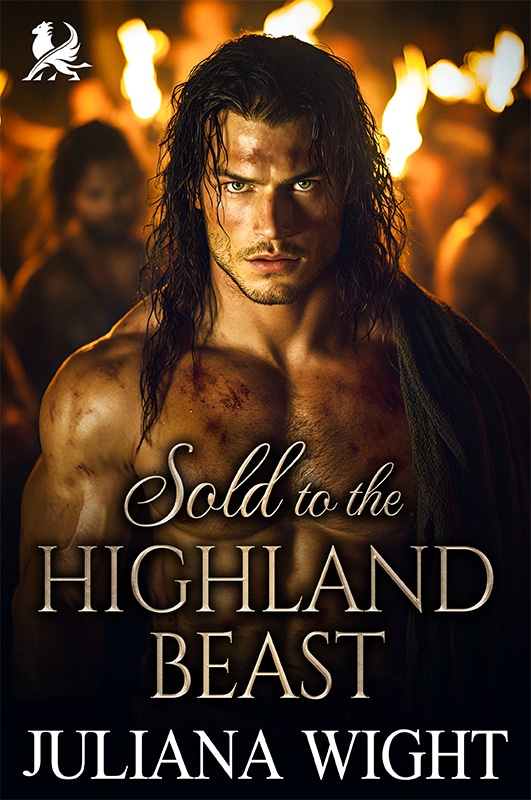
Sold to the Highland Beast (Preview)
Chapter One
Buchanan lands, 1653
The smell of peat smoke clung to the morning air as Kenina Buchanan stepped through the oak gate of the tower house and onto the frost-hardened path leading to the village green. Behind her, the courtyard was only beginning to stir with the stable boy sweeping straw, milk pails clattering and the muted voices of her mother and the stewards from the upper windows already counting grain stores for winter.
Frost crackled under her boots. Her braid slipped again and she shoved it back, smearing flour across her temple.
Not exactly the picture of a laird’s daughter.
Yet the moment she stepped beyond the tower’s shadow, Kenina breathed in the morning air. The village felt more like home than the stone walls behind her.
The green spread before her, and with it, the real bustle began. Women arranged food stores, children chased one another with shrieks of victory, and two shepherds were attempting to untangle their sheep, which had inexplicably tied themselves together.
Today was the Gathering of Stores — a yearly preparation where the clan took stock of winter provisions, repaired what needed mending, and ensured no family lacked warmth or food before the cold months arrived. It was her mother’s tradition, but Kenina had taken the work into her own hands years ago.
Martha, the tower’s housekeeper for longer than Kenina could remember, stood beneath the bare rowan tree watching the chaos with a knife in one hand, the other braced on her hip.
When she spotted Kenina crossing the green, she let out a breath she’d clearly been holding.
“Thank God,” she said, not loudly, but with feeling. “I was just thinkin’ if ye didnae show when ye did, I’d have tae choose between feedin’ folk and stranglin’ them.”
Kenina smiled, taking a look at the pile of sacks next to the long table a few steps away from where they stood. “Who’s earned it?”
“Everyone,” Martha replied flatly. “The sheep are tangled, the grain scales are off, and someone’s left the salt uncovered like we’ve an excess of it.”
Kenina glanced around, taking it in. “I’ll deal with the scales first.”
Martha nodded, satisfaction flickering across her face. “Aye. I thought ye would. Barley wants weighing before the sun softens the frost.”
“And the venison?”
“Already hung,” Martha said. “Yer braither saw tae it before first light.”
That earned a brief nod. “He always liked to have things settled before the noise started.”
“Aye,” Martha replied. “He’s careful that way. Knows folk work better when they’re nae guessin’.”
She handed Kenina a filled sack then. “Take that tae the scales. If the weight’s off again, I want it caught before anyone starts arguing about it.”
Kenina took the load, adjusting her grip as the familiar ache settled into her arms. “I’ll see to it.”
“Good,” Martha said, already turning back to the green. “And if those shepherds start in again, tell them the sheep aren’t the problem.”
As Kenina began working, the green filled more fully. Folk drifted closer in ones and twos, drawn by the open sacks and the quiet order taking shape beneath the rowan tree. Barley was weighed. Oats counted. Names marked in chalk beside tallies scratched into a slate board.
This was the part she liked, when chaos thinned into recognizable pattern.
“Lady Kenina,” Deirdre the baker’s wife said, approaching with her youngest perched on her hip. The boy’s nose ran freely, red with cold. “Daes he feel warm tae ye?”
Kenina wiped her hands on her apron and pressed her fingers briefly to the child’s brow. Cool. A little clammy, but no heat beneath it. “Nay fever. He’s been standing by the ovens again, hasn’t he?”
The boy sniffed guiltily.
Kenina continued, “Keep him away from the smoke for a day or two. Let him play outside — wrapped well. If he starts coughing at night, bring him back.”
Deirdre sighed in relief. “Bless ye. The laird should’ve made ye a healer instead of an heiress.”
“She can be both,” Martha muttered, scooping barley into empty sacks with crisp efficiency.
That earned her a faint smile. Deirdre shifted her grip and moved on, the boy already squirming to be let down.
Kenina returned to the grain. The rhythm soothed her. Scoop. Weigh. Tie. Pass it on.
She knew who needed extra. The MacRaes, whose eldest limped too badly now to hunt. Old Morag, whose stores were always thinner than she admitted. She made small adjustments where she could — nothing obvious, nothing that would shame — just enough to keep winter from biting too hard.
A woman caught her wrist briefly as Kenina handed over a sack.
“Bless ye, lass. We are grateful fer yer help.”
The words struck a soft place in her chest. Kenina smiled.
“I just want everyone prepared before the worst of the cold.”
“And they will be. Because of ye.”
She returned to the tally board, chalk dust smearing her fingers as she marked another name. The work demanded attention. That was the point of days like this — not ceremony, not speeches, but presence. Her mother had taught her that early.
If the people see one counting alongside them, they trust the count.
The Buchanans had ruled this way for generations. Quiet authority. Visible hands.
Her father believed a laird who stayed behind stone walls forgot the sound of his people’s needs. Her mother believed that a household — even a clan — ran on preparation more than strength. Kenina had grown up between those truths, carrying both.
She shifted a sack closer to the older men waiting near the fence, watching as they tested the weight with practiced hands. One nodded approval. Another gave a grunt that passed for gratitude. It was enough.
Kenina reached for another sack.
And stopped. She thought she felt the ground tremble.
Her fingers curled once against the coarse cloth of the sack instinctively. But after listening an hearing nothing, she went back to filling the sack up,
The sound of horses suddenly filled the air and Kenina froze mid-motion. “Did ye feel—?”
A scream cut her off.
It didn’t sound like a child’s squeal of play, but the kind that scraped bone.
Kenina’s heart lurched. She spun toward the sound.
A horn blast shattered the morning. Kenina’s heart punched against her ribs. “That’s not ours.”
Chaos hit like a wave.
Mothers grabbed children. Men dashed for tools that could pass as weapons. Dogs barked madly, sensing the fear before the humans did.
“The Grahams!” someone shouted from the wall. “The Grahams are here! It’s another raid.”
Kenina dropped her basket so hard its contents scattered across the dirt. “We need tae move, help me get the children inside the storehouse!” she screamed to a villager, Fergus, who stood nearby.
A group of little ones stood frozen near the well, eyes huge, unsure where to run. Another horn wailed, closer this time.
“Fergus!” she barked. “Take the children—go!”
To his credit, he didn’t argue. He scooped up a crying toddler and herded three others with frantic gestures.
At the far end of the green, a woman stumbled from between the cottages, blood streaking her sleeve, eyes wide with terror.
“Raiders!” she shrieked. “From the east road! Raiders!”
Martha stormed over to their side, swearing under her breath. “Where’s the laird? Where’s yer faither? They were out huntin’ —”
“Aye,” Kenina breathed, throat tight. “And Lachlan with them. He was leadin’ the younger men.”
Martha swore — an old Hebridean curse sharp enough to cut the air. “Saints preserve us. That means half the trained fighters are gone.”
In an instant she understood. The raiders had chosen their moment well. Too well.
Before Kenina could answer, another scream split the morning. This one was closer.
Followed by a crack—wood hitting wood. Or skull.
Kenina caught Martha by the wrist before she could step forward. The woman had gone still, eyes fixed beyond the green, mouth parted as if she’d forgotten how to close it.
“Martha,” Kenina said low. “Look at me.”
Martha blinked once, then dragged in a breath through her nose. Her grip tightened in return.
“Listen,” Kenina said, voice dropping. “If they were after cattle, they’d have turned toward the lower fields by now.”
Martha turned to look beyond the green. Kenina followed her gaze. The riders were angling straight through the narrow road between the cottages.
“Too tight a line,” Martha trembled. “No scatter.
Kenina’s jaw set. “They’re comin’ straight fer the green.”
Martha drew in a breath. “Aye.”
Kenina’s eyes narrowed. “This isn’t a chance raid. Someone knew the laird was gone.”
She turned, skirts already gathered in one hand as she moved. “Martha — get the elderly inside the chapel and the granary. Bar the doors. Anyone who can’t move fast goes with ye.”
Martha hesitated only a heartbeat, then nodded once and moved, voice rising sharp and commanding.
Another crash shook the ground beneath their feet
Kenina didn’t think. She lunged toward the group of children nearest her.
“Breanna!” she shouted. “Gather the wee ones—now!”
Breanna froze in fright.
Kenina grabbed her shoulders. “Look at me.”
The girl’s eyes locked on hers.
“We go tae the barley store. It’s thick-walled and it stays cool, they won’t think to look there. Ye run first. Run!”
Breanna nodded once, then bolted, calling the younger children with frantic whispers.
Kenina pivoted, scanning the green. She spotted two boys near the well clutching each other, rooted in terror. She swore softly as she ran over to them, dropping to one knee so she was eye level, voice sharp but steady despite having run a little distance.
“Listen tae me. Ye’re goin’ tae run straight tae the storehouse. Dae ye see it? Good. Dinnae stop. Dinnae look back.”
One of them shook so badly she thought he might cry.
She pressed her palm flat between his shoulder blades. “Ye’re brave enough,” she said quietly. “Now go.”
They nodded, trembling. She pushed them forward, urging them into motion.
Kenina turned back just as the first raiders broke fully onto the green. They were fur-clad and armed with axes and hooked blades already slick with someone else’s blood, their blood-red cloaks snapping behind them. But it was the colors that marked them unmistakably, the deep forest green and black tartan of Clan Graham, crossed over their shoulders and cinched at their belts. Bronze wolf-head brooches—their clan’s sigil—glinted at their throats.
Behind her, someone shouted in triumph. A heavy thud followed—someone falling. She didn’t turn, she kept running.
Smoke began to curl from somewhere—she didn’t want to think where.
Kenina found and herded four more toward the storehouse. She ducked into the storehouse and shoved the door closed, wedging a broken crate against it, then crouched.
The air inside was cool and thick with the smell of grain. Shapes huddled in the shadows — small bodies, pressed close, barely breathing.
“Stay quiet,” she whispered. “Dinnae move unless I tell you.”
“Lady Kenina…” one boy whimpered, lip trembling.
She brushed his hair back. “I’ll be right here. Ye’ll be safe. I promise.”
Kenina looked around. Another scream sounded—this one closer. Metal clashed violently. The Grahams had breached the outer line already.
Where were Faither and Maither? Where was her brother Lachlan? The warriors should have been there by now.
“Breanna!” she whispered, her eyes straining into the dark. “Breanna, are ye here?”
For a heartbeat there was nothing then a tiny whisper came from behind the barrels, “Here!”
Relief nearly buckled her. Kenina swallowed it down and murmured. “Good lass.”
A small face peered out from behind the stacked barrels, eyes too wide, one clamped over her mouth, the other holding a small human figure.
Kenina crouched and scanned them quickly. Ten. No, twelve. Breanna walked to the center, arms wrapped tight around the youngest, jaw set hard in a way that made Kenina’s chest tighten.
She went to them, moving carefully so her boots didn’t scrape.
She turned as the rest of the kids began to gather around her.
“All right,” she murmured, voice low and even. “Listen tae me. All of ye.”
A few faces tilted toward her. One child’s breath hitched.
“Nay crying,” Kenina said gently. “Nay whispering. Nay matter what ye hear. The walls here are thick. They willnae hear ye if ye dinnae give them reason.”
She met each child’s eyes in turn, holding their attention until the panic eased, just a fraction.
“If ye’re scared,” she went on, “ye hold the grain sacks. Feel them. Count them if ye need tae. But ye stay right here.”
She turned to Breanna and adjusted the girl’s shawl, tugging it low.
“Ye’re the oldest,” Kenina said quietly. “That means ye’re in charge now.”
Breanna’s eyes widened. “Me?”
“Aye. Ye.” Kenina kept her voice calm, certain. “If I dinnae come back right away, ye keep them here. Ye dinnae move unless the chapel bell rings twice. Dae ye understand?”
Breanna swallowed, lip trembling, then nodded. Hard.
She cupped the girl’s cheek, thumb pressing gently beneath her ear, then pushed the barrel just enough to shadow her completely.
“Good lass,” she whispered. “Stay.”
She straightened slowly and moved to the door. There was a crack between the boards where the latch didn’t quite meet. She leaned close and peered out.
The green was no longer chaos — it was worse. Men moving with intent now, fanning out, checking doors, prodding at sheds.
A couple of them were angling that way.
Too close. Kenina’s pulse steadied, sharp and cold. If they reached the storehouse, they would search it.
She leaned back from the door and closed her eyes for one breath.
Then she made her choice.
She turned to Breanna one last time. “Nay matter what ye hear,” she said softly, “ye keep them quiet.”
Breanna nodded again, tears spilling silently now.
Kenina slipped out the door, but she did not run. She walked, just long enough to be seen — long enough for a shadow to catch movement where none should be.
Then she broke into a run.
Her boots struck stone as her skirts swung wide. One of the men shouted. Another laughed.
“Ye there!”
Kenina cut left, then right, keeping to open ground, letting them see her just enough to think they had her measure. She vaulted a low fence and let herself stumble, heard them surge closer.
Good.
She ran harder now, breath burning, heart pounding in her ears. She knocked over a stack of crates, sent them crashing down behind her, and bought herself seconds.
Hooves thundered somewhere. Steel rang.
She didn’t look back, she didn’t need to. She knew they were chasing.
And the storehouse with the children inside it were already fading behind her.
Her lungs were on fire now. Each breath scraped raw, the cold air cutting deeper than the pain in her legs. The ground sloped unevenly ahead, frost slick beneath her boots, and she knew—too late—that she had misjudged the turn.
Her foot slid.
She caught herself on a post, spun and a hand closed around her cloak.
The fabric tore with a sound like a gunshot in the quiet between shouts.
Kenina stumbled forward, dragged back a half step, then wrenched free as the cloak ripped clean from her shoulders. She ran again, skirts gathered, hair coming loose down her back.
Almost clear. Something struck the back of her knee.
Pain exploded. Her leg buckled and she went down hard, palms slamming into frozen earth. The shock knocked the breath from her chest in a sharp, humiliating gasp.
“Found ye,” growled a man in a matted wolf-pelt cloak. His accent was thick, his smile a jagged line. “A pretty one.”
She tried to scramble up.
A boot came down on her calf.
Not crushing. Just enough.
“Stay,” a voice growled above her. Calm. Certain.
She clawed at the ground, fingers slipping in mud and frost. Another hand caught her braid and yanked her head back before she could rise. Her scalp burned. Stars burst behind her eyes.
She cried out despite herself.
Kenina clawed at his wrist, twisting, kicking—anything. But he was stronger, dragging her upright by her hair.
“Let me go!” she spat, scrambling for footing.
He only laughed, breath reeking of ale and rot.
She grabbed his knife hand with both of hers and drove her knee upward. He grunted, grip faltering, and she broke free long enough to stagger back—
But another grabbed her from behind, pinning her arms. Kenina screamed, fury lacing her voice. “Cowards! Let me go!”
The wolf-pelt raider recovered quickly, wiping blood from his lip with the back of his hand as he approached her again.
“Fiery,” he said with a grin. “Good. The laird will like that.”
She looked back for a split second only to see Fergus rushing towards the raider.
Where had he come from? No!
He suddenly barreled into the raider with a broken spear shaft, throwing him off balance for half a heartbeat.
“Run!” he shouted.
A massive arm hooked around her waist.
She gasped as the world spun sideways. The raider she’d lost sight of hauled her back by sheer brute force.
“Let—go—of me!” She drove her elbow back, catching him in the ribs. He grunted but didn’t loosen his grip.
Fergus lunged again, but another Graham slammed into him, sending him sprawling across the dirt. His body fell limp.
“Fergus!”
Her scream tore raw from her throat.
He reached for her helplessly, breath knocked from his chest. “K-Keni—!”
The raider hoisted her off her feet as if she weighed nothing. Kenina kicked, clawed, twisted—her braid snapped against her cheek, her lungs burned with terror.
“Faither!” she screamed. “Lachlan!”
She was thrown to her knees and the wolf-pelt man grabbed her chin roughly.
“Where’s yer laird, girl?”
Kenina glared, breathing hard through pain. “Coming fer ye.”
Another strike, backhanded this time, snapped her head sideways. She fell to the side hitting her head hard on a tree.
Through the ringing in her ears, she heard the distant horn.
A deep, familiar bellow echoing through the trees.
Her father’s war horn.
Her heart soared—only for the hope to crack an instant later as the raider behind her tightened his grip.
“Take her,” wolf-pelt ordered. “Before the laird’s men arrive.”
“Nay!” Kenina kicked, twisted, fought wildly but the world was tilting, her senses spinning from the blow.
They dragged her toward the tree line, boots skidding across frost, her fingers scraping hopelessly against the earth.
Kenina went, stumbling once, then straightening despite the pain screaming through her knee. She lifted her chin as they marched her back toward the green.
The children were hidden. They had chased her.
She had done what she had set out to do.
Then the raiders pulled Kenina into the cold of the forest just as the horns of her father’s warriors thundered onto the green.
Chapter Two
Kenina woke to the sway of movement and the sting of rope biting into her wrists.
Cold air slapped her face as the hood was yanked off. Dawn had barely broken, but the world already felt grey and starved of warmth. She was tied to a long, thick rope that connected her to a line of other captives—villagers, a few younger warriors, two boys scarcely older than twelve. Their breaths steamed into the air like frightened ghosts.
A Graham rider on horseback barked, “On yer feet! Move!”
The prisoners stumbled forward. Kenina forced herself upright, legs shaking with the lingering shock of being dragged half-conscious through the forest. Her throat ached from screaming. Her wrists pulsed where the rough bindings scraped her skin.
Two Grahams pushed her forward.
She stumbled. “I can walk, ye bastards!”
A sharp fist slammed into her stomach. She doubled over, gasping.
“Try that tone again—see what happens,” the rider snarled, yanking her hair.
Kenina spat blood onto his boot.
He kicked her in the ribs.
A few villagers cried out for him to stop, but a sword pointed their way silenced them.
Kenina straightened slowly. Pain wriggled beneath her ribs like a hot coal, but she refused to bend again. The chain of prisoners trudged on.
The cold forest creaked around them. Frost coated the ground. Crows circled overhead, their calls sharp and mocking. Kenina’s breath was shallow, each inhalation tasted of iron and damp earth. They had walked for hours the day before and her mind kept flashing images of Fergus lying in the dirt like a broken doll. Were there even survivors?
She swallowed hard.
Time dissolved into the ache in her ankles and the rawness of her throat. The Grahams kept a relentless pace, whipping anyone who slowed.
By midday, the trees had thinned, revealing a squat stone fort pressed against a ridge. Smoke rose from its chimneys and wooden palisades ringed the walls, scarred by years of raids.
Two Graham sentries watched the prisoners approach with bored amusement. One of the leered at the prisoners. “More stock, aye? Good haul by the look o’ them.”
Kenina’s jaw clenched so hard her teeth ached.
Inside the gates, the prisoners were corralled into a muddy yard as men inspected them like livestock. Some collapsed immediately. Kenina stayed standing by sheer force of will. Some Grahams poked at injuries, lifted chins, pulled hair, appraised muscle.
One grabbed Kenina’s chin. “Pretty one. She’ll fetch high.”
“She’ll bite yer bloody fingers off,” she snapped, jerking her face away.
He raised a hand to strike her. But a voice cut through the yard like a blade:
“Enough.”
The murmuring died instantly.
The crowd parted as a man approached.
Tall, well-kept, with a wolf-pelt cloak bearing his colors draped over his broad shoulders, he walked with an air of ownership. His cold eyes swept across the prisoners.
Kenina had heard plenty about him. Keir Graham, the border laird who raided not for vengeance, but for profit. A man who smiled at cruelty because he found something pleasing in it.
Then he saw her.
The corners of his mouth curled slowly, as though savoring the sight. “Well now,” he said softly, “look at ye.”
Her stomach dipped. She tried to keep her expression blank. She would die before giving him fear.
Graham took his time walking around her, steps measured, hands clasped behind his back. His gaze moved over her as if taking inventory. She felt stripped without a finger laid on her.
“I ken ye,” he murmured. “From Buchanan lands.”
Kenina swallowed. “I dinnae ken ye.”
“Oh, but ye dae,” he said softly. “Yer faither showed ye off once, years ago, when I visited tae settle a border dispute. Ye were what—sixteen? Already a beauty. Already proud.”
He leaned in just enough for her to feel the warmth of his breath. “I didnae expect one of yer quality tae fall intae me lap.” His smile widened, sick with pleasure. “Coin like this only comes once.”
Her jaw clenched. “I’m nae coin.”
He tapped her cheek once lightly. “Aye, lass,” he whispered. “Ye are exactly that.”
His fingers brushed her hair.
She recoiled as if burned. “Touch me again, and I’ll tear your hand off.”
He laughed low and delighted.
“Spirited. I remember thinkin’ it then. And now look at ye…” His gaze sharpened into hunger. “A rare prize indeed. I thought I’d never catch such a gem fer me auctions. The nobles in the east will fight over ye.”
The Graham warriors laughed at their laird’s words.
Kenina’s heart slammed painfully against her ribs.
Auction?
He turned away, already speaking to the guards.
“Get her washed. Fed. Nae too much—dinnae soften her. She goes tae auction tomorrow.”
***
The hood scratched against Peadar’s jaw as he moved through the shadows of the ruined stables, the scent of old leather and damp hay thick in the cold night air. His breath ghosted before him, visible in the lamplight spilling from the half-open barn doors ahead.
The stench of tallow smoke clung to Peadar’s clothes as he slipped into the back of the Graham byre. Lamps flickered low, shadows moving across the walls like restless spirits. Men crowded the room, muttering, jostling, boots grinding straw into the dirt.
He kept his hood low. Tristan walked at his shoulder, stiff as a pike.
“Saints,” Tristan muttered. “If filth had a home—”
“Keep yer tongue quiet,” Peadar said under his breath. “Grahams have ears like rats.”
His own pulse thrummed with a familiar coldness — the same cold that carried him through battles, ambushes, funerals.
Taenight, we get what we came fer. Drummond falls.
“Ye remember the plan,” Tristan murmured without looking at him.
“Aye,” Peadar said. “Get in. Listen. Buy naething. Draw nay notice.”
Tristan’s mouth pulled tight. “Then let’s pray tae God ye follow yer own instructions.”
Peadar didn’t dignify that with an answer.
He scanned the byre, taking notes of crates, of several slaves, stolen goods and livestock penned for sale. The air was warmer, but only because of bodies — men pressed shoulder to shoulder, breath sour with ale and anticipation. Lanterns hung on hooks between wooden beams, throwing slick amber light across a makeshift platform at the far end. A long table stood near it, cluttered with ledgers, quills, and coin purses.
Torcull Drummond stood at the front, smug as a crowned pig — fox-fur cloak, jeweled brooch, drink in hand, his belly straining against his belt.
Peadar’s jaw tightened. Drummond. The man who had set the war in motion, the man who had burned Glen Torrin, the man who had stood watching while Peadar’s mother had screamed.
His hand twitched toward the dagger hidden under his cloak.
“Easy,” Tristan warned.
“I’m calm,” Peadar murmured.
He wasn’t.
Tristan shot him a warning glance. “We dinnae intervene,” he whispered. “Nae unless ‘tis proof or Torcull himself.”
Peadar didn’t respond. He focused on his breathing instead. Rage had no place there. Rage made men stupid, and stupid men got caught.
They found a narrow place near the back wall, half-hidden behind stacked sacks of grain. A perfect vantage point. Perfect distance. The place where a man could watch everything without being watched himself.
Peadar leaned against the wall, arms folded, feigning the indifference of a man who’d come for bargains. Then the auction started.
Keir Graham, the Graham laird stomped onto the platform. “Taenight,” he called, “we’ve goods rare and fine. Weapons. Livestock. Servants.” He grinned, revealing a row of yellow teeth. “And a treasure or two.”
Disgust crawled up Peadar’s throat, but he didn’t move.
The auction began and the men present started making their bids. After about half an hour Keir Graham stepped back out.
“Next lot!” he announced with a sly smile. “Clan Buchanan’s prized heir.”
A Graham guard dragged Kenina forward by the arm. She stumbled, caught herself, then straightened her spine.
A murmur went through the crowd. Peadar felt it like a shift in air pressure. Clan Buchanan? He narrowed his eyes, confused. Buchanan heirs did not end up on auction blocks by accident. Why would a Buchanan heir be—
The girl was pushed into the lamplight, and Peadar forgot to breathe.
Her wrists were bound loosely, rope more for display than restraint, but it drew the eye to the narrowness of her waist, the clean lines of her arms. Her dress hung torn and dirty at the hem, clinging in places where it had no right to cling.
The bodice was creased and pulled, the fabric stretched over a figure that was unmistakably female — slim but full where it mattered, hips soft beneath the rough wool, shoulders straight with a strength that had nothing to do with delicacy.
Her chestnut hair fell in thick dark braids, loosened from struggle, glossy even in the poor light. A few strands had escaped, brushing her cheek, catching at her mouth. Her lips were parted just slightly, breath controlled but fast, as if she were forcing herself not to show how hard that cost her.
She lifted her chin.
The lamplight caught her face fully then, and Peadar felt the hit of it low and hard in his gut.
She was beautiful. Beautiful in a way that drew attention whether she wanted it or not. High cheekbones dusted with freckles and grime, a mouth made for smiles rather than frowns, her hazel eyes dark and sharp beneath strong brows — eyes that did not plead, even then. There was fear there, aye, but it was reined in, held tight behind iron control.
Something cold plunged through Peadar’s gut, so sharp it stole his breath.
She was too much woman for this place.
She did not look like a girl who broke easily.
Tristan leaned close. “Is that—?”
“Aye,” Peadar muttered. “Buchanan blood.”
He told himself to look away. He couldn’t.
Because every man in the room was looking at her, with hunger, ownership, calculation. Their eyes dragged over her openly— the line of her throat, the curve of her waist, the way her breasts rose beneath the torn bodice when she drew breath.
His jaw tightened.
Torcull Drummond stepped out of the crowd, his grin widening. “At last,” he drawled loudly. “A lass worth me coin.”
Several men laughed.
The girl flinched. Not outwardly but Peadar saw the quick pulse at her throat, the way her fingers curled, white-knuckled, around the rope.
Keir Graham leered. “Here she is, lairds—Kenina Buchanan, blood heir tae everyone’s favorite enemies. Look at her. Fine bones. Fine breeding. Fine future fer any man who can keep her… compliant.”
A ripple of lewd laughter passed through the hall.
He saw her jaw tighten.
He looked Kenina over slowly, deliberately.
“Turn her,” he ordered the guard.
The guard shoved her by the shoulder. She jerked away but didn’t have the strength to stop him. Her braid swung loose, dark against her pale skin.
Then Torcull clicked his tongue. “Bonnie, in a fragile sort of way. Pity about her clan. They’ve always been stubborn bastards.”
Graham clapped. “We’ll start the bidding at forty sovereigns.”
“Forty?” someone barked. “Fer a lass?”
“She’s an heiress,” another argued. “Worth ten times that.”
“Aye, if ye want trouble with the Buchanans,” someone else scoffed.
Drummond wagged his finger. “I’ll start the bid. Forty sovereigns.”
Gasps rippled. That was enough to buy cattle herds.
Graham nearly choked on his spit. “Ah—aye, Laird Drummond begins with forty!”
A man to Peadar’s right snickered. “He wants her fer more than politics, eh?”
“Likely as nae,” another said, “he’ll breed her quiet.”
“Aye,” came the reply. “And what Torcull wants, Torcull takes.”
Peader frowned, his mind turning in circles. He told himself she was not his concern. He didn’t even like the Buchanans, but this? This was filth. The same filth that had filled the war. Men who believed no one could stop them. His eyes stayed on her.
Peader watched as she swallowed hard, her eyes flicking across the room.
Drummond lifted his chin. “Fifty.”
The byre buzzed again.
Peadar forced himself to breathe.
Stay focused. Get the evidence. Leave.
“Fifty,” Drummond said, savoring it.
The girl’s face drained of color.
Peadar didn’t realize he’d straightened away from the wall until Tristan’s fingers dug into his sleeve.
Peadar’s teeth clenched so hard his jaw ached. Tristan elbowed him. “Dinnae even think—”
“Fifty-one.” The word left Peadar’s mouth before Tristan finished his sentence.
The room snapped toward him. Silence fell, heavy and dangerous.
Drummond’s head jerked around. “Who said that?”
Peadar stepped forward, pulling back his hood. The murmurs swelled — some startled, some amused, some afraid.
Tristan hissed through his teeth, “Ye bloody lunatic. Ye gone and done it.”
Graham blinked at Peadar. “S–sir, that’s—”
Torcull cut in, voice like steel dragged over stone. “Name yerself, stranger.”
Peadar lifted his chin just enough to show the line of his jaw beneath the hood.
“Only a man making a purchase.”
Torcull’s eyes narrowed. “Ye mock me.”
“Nay,” Peadar said calmly. “But if ye think I fear ye… aye, that’s the mockery.”
A few men gasped. Someone whispered, “Christ preserve him.”
A man stepped up to Drummond and whispered into his ear and Drummond turned to stare at Peadar, incredulous. “Ye? The MacGregor mongrel? Ye think tae bid against me?”
Peadar lifted his chin. “I just did.”
Torcull stepped forward, voice low and dangerous. “Dae ye ken who I am?”
Peadar met his stare, cold as winter.
“Oh aye. And I hope ye ken I dinnae back down.”
“Fifty-five,” Drummond snarled, eyes glittering.
Peadar didn’t blink. “Sixty.”
A roar went through the crowd, half shock, half delight at the brewing fight. A man near him coughed ale up his nose.
Drummond’s cheeks reddened with rage. “Ye dare—”
“She looks cold,” Peadar said evenly, cutting him off. “I’d prefer she nae rot afore she’s worth the coin.”
A few men laughed nervously. Drummond’s hand twitched like he wanted his sword, but the Grahams blocked him — no bloodshed till after the auction.
Graham cleared his throat. “Sixty fer the lass—”
“Sixty-one—” Drummond barked.
“Sixty-five,” Peadar said, louder.
His voice vibrated through the rafters.
Kenina’s gaze snapped to him — startled, wary, confused. She looked at him like he was another threat, another enemy.
He ignored the look.
Graham swallowed. “Sixty-five—goin’ once—goin’ twice—”
Drummond took one step toward Peadar.
“Ye are a dead man.”
Peadar didn’t break eye contact. “Get in line.”
“Sold!” Graham shouted, slamming his staff.
The byre erupted in cheers, jeers, curses. Drummond looked murderous.
Peadar’s stomach twisted — not with regret, but with certainty.
He had just made Torcull Drummond his personal enemy.
Good.
He wanted the bastard watching when he destroyed him.
If you liked the preview, you can get the whole book here